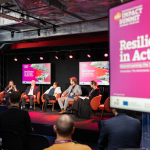
At last week’s Euclid Network Impact Summit 2026, the AI for Impact (Top 100 Women in Social Enterprise meet AI Tides) session cut through a lot of the noise around artificial intelligence.
Instead of big claims about transformation, the conversation stayed grounded: what is AI actually useful for in social impact work right now and where does it fall short?
Bringing together women social entrepreneurs, facilitators, and ecosystem actors, the session combined short, focused inputs with a more open panel discussion. The result was a session that felt practical, candid, and occasionally challenging.
Starting with Practice, Not Theory
The session opened with rapid-fire inputs from:
-
Jenny Romano – Co-Founder of The Newsroom
-
Cynthia Reynolds – Founder & Convener of the Circular Economy Coalition
-
Katerina Chantzi – Co-Founder of Lysistrate
-
Greta Rossi – Facilitation Consultant at ChangemakerXchange
Each speaker shared how AI shows up in their work. Across the examples, AI wasn’t positioned as a headline innovation. It showed up in quieter, more operational ways:
-
Making sense of large amounts of information
-
Supporting pattern recognition across complex systems
-
Helping teams make faster, more informed decisions
But what made this segment engaging wasn’t just the use cases, it was the framing.
There was a clear emphasis on intentional use. AI was treated as something to be integrated carefully, not adopted wholesale. Speakers pointed to the limits just as much as the opportunities, especially when working in contexts shaped by inequality, informality, or resource constraints.
The Bigger Question: What Changes, Really?
The second half of the session opened up the conversation.
Introduced by a short clip from AI and Impact by Dave Lyons (, the panel discussion moved from individual examples to system-level questions: if AI is becoming more embedded in social impact work, what actually changes and who decides?
A few tensions came up repeatedly:
-
Efficiency vs. purpose
AI can make things faster but faster doesn’t automatically mean better, especially in work that depends on trust, relationships, and lived experience. -
Access vs. concentration
While AI tools are becoming more available, meaningful use still depends on skills, infrastructure, and funding not evenly distributed across the sector. -
Innovation vs. inclusion
Without careful design, AI risks reinforcing the same inequalities many social enterprises are trying to address.
Where the Energy Was
What made this session stand out wasn’t just the content, but the interaction.
The format left room for ongoing Q&A, and the discussion didn’t stay abstract for long. Questions from the audience pushed speakers to get specific about failed experiments, internal resistance, and the gap between expectations and reality.
There was also a noticeable shift in tone compared to typical AI conversations. Less urgency to “adopt,” more focus on how to adopt well or whether to at all.
Connecting the Dots
One of the more interesting threads running through the session was the disconnect between:
-
Social enterprises experimenting with practical, grounded uses of AI
-
Larger institutions shaping how AI is funded, built, and governed
The session didn’t resolve that gap, but it did make it visible.
And it raised a useful question: how can insights from organisations working closest to communities actually influence the direction of AI at scale?
What Stays After the Session
A few things felt clear by the end:
-
AI is already part of the toolkit for many social enterprises but in limited, specific ways
-
Its value depends heavily on context, not just capability
-
The biggest challenges are still structural, not technical
-
There’s a need for stronger links between grassroots practice and system-level decision-making
If anything, the session made AI feel less like a turning point and more like an evolving tool, one that’s only as useful as the thinking, values, and constraints around it.
And for now, that’s probably a more honest place to start.